LPCV-Track-1
LPCV - Low Power Computer Vision
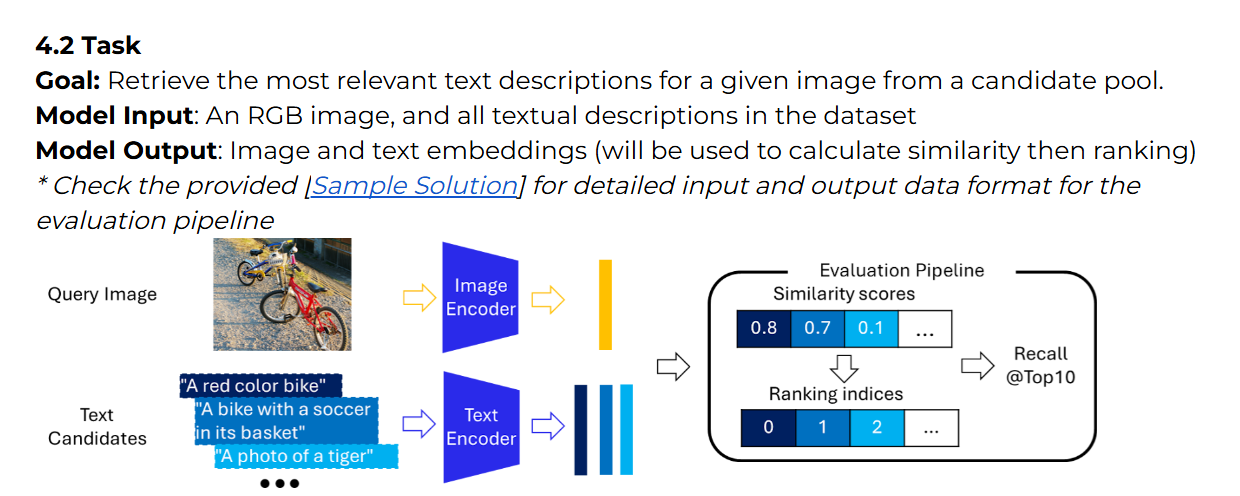
To-Dos:
- Implement the sample solution
- Find relevant papers
- Create Repo
- Run the sample solution
- Collect relevant datasets
- prepare baseline
- create pipeline to train easily on vast.ai
Ideas
The current State-of-the-Art (SOTA) involves moving beyond simple contrastive learning toward methods that handle hard negatives, compositional logic, and parameter efficiency.
1. High-Level Fine-Tuning Approach
The standard objective is the InfoNCE (Contrastive) Loss. You feed the model batches of $(Image, Text)$ pairs and train it to maximize the cosine similarity of matching pairs while minimizing it for all others in the batch.
The “SOTA Recipe”:
Initialize with Pre-trained Weights: Start with
ViT-L/14orViT-H/14from OpenCLIP.Use a Small Learning Rate: Typically $1 \times 10^{-5}$ to $5 \times 10^{-6}$. CLIP is sensitive; a high LR will destroy the pre-trained features (catastrophic forgetting).
Large Batch Size: Contrastive learning relies on having many “negatives” in a batch. If hardware is limited, use Gradient Accumulation.
2. SOTA Methods & Techniques
A. Semantic Refinement & Angular Margin (CLIP2SRITR)
Standard CLIP uses a simple dot product. Recent methods like CLIP2SRITR (2025) introduce an Additive Angular Margin (similar to ArcFace). This forces the model to not just “separate” images and text, but to create a highly compact cluster for related concepts, significantly boosting Recall@K.
B. Handling Negation & Composition (NegCLIP / CLIPGlasses)
A common failure of CLIP is “bag-of-words” behavior (it can’t tell the difference between “a red bike with a blue basket” and “a blue bike with a red basket”).
Method: Fine-tune using Hard Negative Mining. For every correct caption, include “shuffled” or “negated” captions as negatives in the same batch.
Source: Enabling CLIP to Comprehend Negated Visual Descriptions (2026).
C. Parameter-Efficient Fine-Tuning (PEFT/LoRA)
Instead of updating all billions of parameters, use LoRA (Low-Rank Adaptation). This keeps the original CLIP “knowledge” frozen and only trains small adapter layers.
- Benefit: Prevents the model from over-fitting to your specific dataset (e.g., COCO) and maintains its general-purpose “zero-shot” ability.
D. Feature Map Distillation
Standard CLIP only looks at the global [CLS] token. SOTA methods now use Feature Map Distillation to force the image encoder to pay attention to spatial tokens (patches). This helps in retrieving images based on small objects mentioned in the text (like “the soccer ball in the basket”).
3. Relevant Sources & Repositories
| Category | Source / Paper | Key Link/Identifier |
|---|---|---|
| Code (The Best) | OpenCLIP | GitHub: mlfoundations/open_clip |
| Library | Hugging Face PEFT | For LoRA/Adapters implementation |
| SOTA Paper | CLIP-based Semantic Refinement Method | CLIP2SRITR (2025) |
| SOTA Paper | Negated Visual Descriptions | arXiv:2602.21035 (2026) |
| Benchmark | CLIP Benchmark | GitHub: LAION-AI/CLIP_benchmark |
Implementation Tip
If you are working on a specific dataset (like the one in your image with “red color bikes”), I recommend starting with LoRA fine-tuning on the MS-COCO dataset using the OpenCLIP library. It is the most stable path to high Recall@10 scores.