Curriculum Learning
Last modified: July 21, 2026
#curriculum_learning
The original definition of Curriculum Learning (CL) was formally proposed by Bengio et al. in 2009. They defined a curriculum as a sequence of training criteria over $T$ training steps, denoted as:
$$\mathcal{C} = \langle Q_1, \dots, Q_t, \dots, Q_T \rangle$$Each criterion $Q_t$ represents a reweighting of the target training distribution $P(z)$ at a specific step $t$. $Q_{t}(z) ∝ W_t(z)P (z) \quad ∀ example z ∈ training\, set\, D$
To be considered a curriculum under the original definition, the sequence must satisfy three specific conditions:
- Increasing Entropy (Diversity): The entropy of the distributions must gradually increase ($H(Q_t) < H(Q_{t+1})$). Ensuring that info and diversity in training data increases.
- Monotonic Weight Increase: The weight assigned to any specific training example must increase or stay the same over time ($W_t(z) \leq W_{t+1}(z)$). This weight is essentially applied on the loss from said data point.
- Target Distribution Convergence: The final training criterion must be equal to the target training distribution ($Q_T(z) = P(z)$). This ensures that the model eventually trains on the full, original dataset with uniform weights for all examples.
Why do Curriculum Learning?
- Speeds up convergence
- improve model generalisation over unseen data
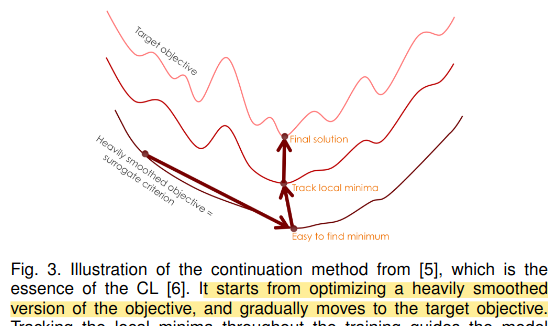
- More stable training over the loss curvature. doesn’t get stuck at poor local minima.
Curriculum Design
- Difficulty Measurer - What kind of data is easy or harder to learn?
- Training Scheduler - When to present harder data and how much harder?
Predefined CL
When both DM and TS are designed based on human’s prior knowledge without involvement of any data-driven algorithms.