DIFFUSION POSTERIOR SAMPLING FOR GENERAL NOISY INVERSE PROBLEMS
#diffusion
Main Contributions
- we extend diffusion solvers to efficiently handle general noisy (non)linear inverse problems via approximation of the posterior sampling.
- incorporate various measurement noise statistics such as Gaussian and Poisson, and also efficiently handle noisy nonlinear inverse problems such as Fourier phase retrieval and non-uniform deblurring.
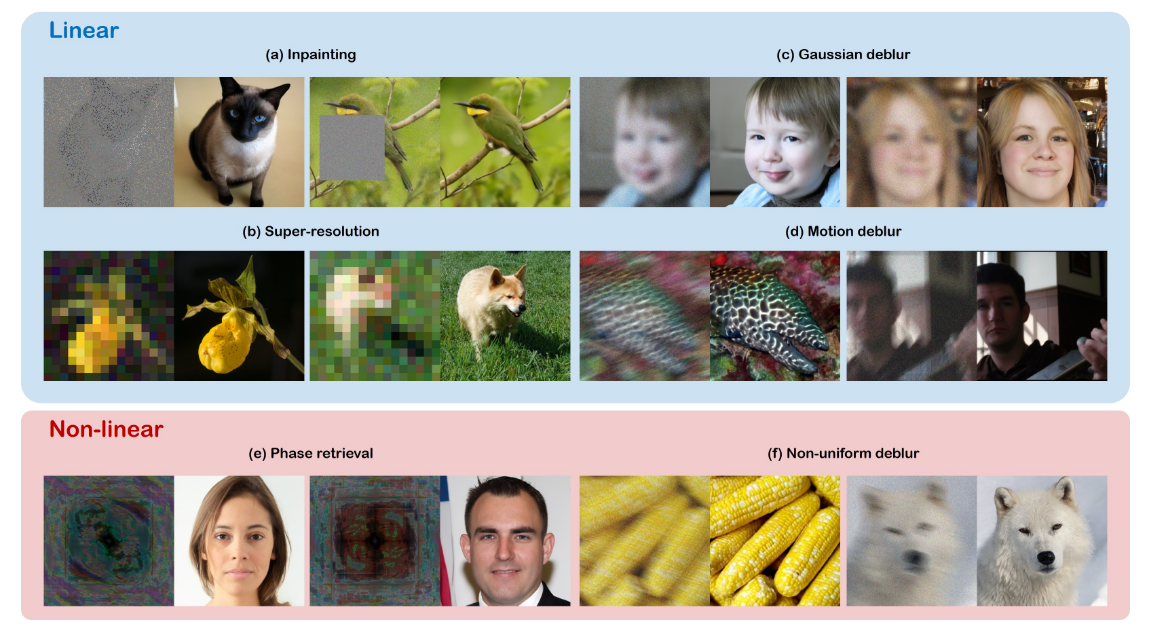 Some inverse problems and their solved results.
Notes:
- In this work, they have considered the variance preserving (VP) form of the SDE (Song et al., 2021b) which is equivalent to Denoising Diffusion Probabilistic Models
Background
 This the typical conditional score matching loss, optimising which also leads to minimization of the unconditional score matching loss. Once $θ^{*}$ is acquired through (3), one can use the approximation$\nabla _{x_t}\log p_{t}(x_t) ≃ s_{θ^∗} (x_{t}, t)$ as a plug-in estimate to replace the score function in the reverse SDE to sample from the original distribution.
we have a partial measurement y that is derived from x. When the mapping x 7→ y is many-to-one, we arrive at an ill-posed inverse problem, where we cannot exactly retrieve x. In the Bayesian framework, one utilizes p(x) as the prior, and samples from the posterior p(x|y).
 The above equation is the reverse SDE used to sample from the posterior distribution by considering the posterior of each intermediate step $x_t| y$ , which is typical of a inverse problem setting.
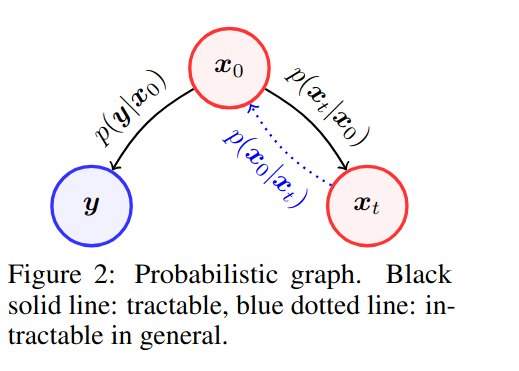
 Consider the above measurement model. It is clear that y and x_t do not have any explicit dependency as given in the probabiltiy graph below.