Nearest 0 from cell in a matrix
#cp-medium
Given an m x n binary matrix mat, return the distance of the nearest 0 for each cell.
The distance between two cells sharing a common edge is 1.
Example 1:
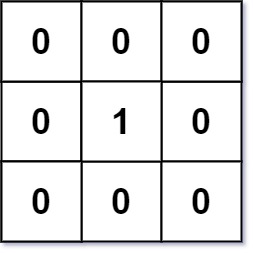 Inpu
t: mat = [[0,0,0],[0,1,0],[0,0,0]]
Output:[[0,0,0],[0,1,0],[0,0,0]]
Inpu
t: mat = [[0,0,0],[0,1,0],[0,0,0]]
Output:[[0,0,0],[0,1,0],[0,0,0]]
Example 2:
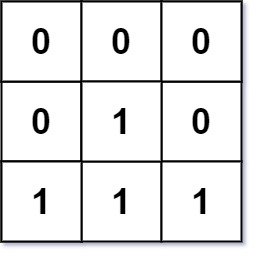 Input: mat =\ [0,0,0],[0,1,0],[1,1,1]]
Output: [[0,0,0],[0,1,0],[1,2,1]]
Input: mat =\ [0,0,0],[0,1,0],[1,1,1]]
Output: [[0,0,0],[0,1,0],[1,2,1]]
Constraints:
m == mat.lengthn == mat[i].length1 <= m, n <= 1041 <= m * n <= 104mat[i][j]is either0or1.- There is at least one
0inmat.
Naive Solution
I did BFS from each cell and calculated the nearest cell with 0. Complexity -> (MN * (M+N))
class Solution:
    def updateMatrix(self, mat: List[List[int]]) -> List[List[int]]:

        m = len(mat)
        n = len(mat[0])

        zeros = [[-1 for _ in range(n)] for _ in range(m)]

        for a in range(m):
            for b in range(n):

                visited = [[0 for _ in range(n)] for _ in range(m)]

                que= []
                que.append((a,b,0))

                while que:
                    i,j,pos = que.pop(0)

                    if mat[i][j] == 0:
                        zeros[a][b] = pos
                        break

                    print(i,j)
                    visited[i][j] = 1
                    # print(visited)
                    dirs = [(i+1,j),(i,j+1),(i,j-1),(i-1,j)]

                    pos+=1
                    for adj in dirs:
                        p,q = adj
                        if p>=0 and p<m and q>=0 and q<n and not visited[p][q]:
                            que.append((p,q,pos))
                            # print(adj)

        return zeros
Optimal Solution
Notice that we can think of this in the reverse way - a flood fill starting from the nodes with 0. all non-zero nodes next to 0 will have 1 as the distance. In the next phase, the nodes next to those with distance 1, will get distance 2 and so on till all nodes have been visited.
We can also think of this like a graph where at the 0th layer we have all the 0 nodes, and then the adjacent nodes are the 1st layer and so on layer wise. And we basically need to find the layer of each corresponding node.