Rotten Oranges
Last modified: July 21, 2026
#cp-medium
You are given an m x n grid where each cell can have one of three values:
0representing an empty cell,1representing a fresh orange, or2representing a rotten orange.
Every minute, any fresh orange that is 4-directionally adjacent to a rotten orange becomes rotten.
Return the minimum number of minutes that must elapse until no cell has a fresh orange. If this is impossible, return -1.
Example 1:
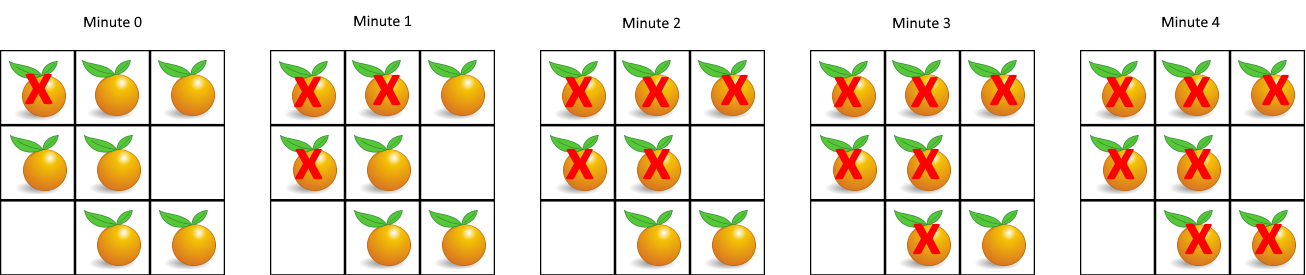
Input: grid =
\[ [2,1,1],[1,1,0],[0,1,1]\]Output: 4
Example 2:
Input: grid =
\[[2,1,1],[0,1,1],[1,0,1]\]Output: -1 Explanation: The orange in the bottom left corner (row 2, column 0) is never rotten, because rotting only happens 4-directionally.
Example 3:
Input: grid = [[0,2]] Output: 0 Explanation: Since there are already no fresh oranges at minute 0, the answer is just 0.
Constraints:
m == grid.lengthn == grid[i].length1 <= m, n <= 10grid[i][j]is0,1, or2.
Approach
Just at each minute, do 1 step of bfs from each of the rotten cells.
Soln
from collections import deque

# Time complexity: O(rows * cols) -> each cell is visited at least once
# Space complexity: O(rows * cols) -> in the worst case if all the oranges are rotten they will be added to the queue

class Solution:
    def orangesRotting(self, grid: List[List[int]]) -> int:

        # number of rows
        rows = len(grid)
        if rows == 0:  # check if grid is empty
            return -1

        # number of columns
        cols = len(grid[0])

        # keep track of fresh oranges
        fresh_cnt = 0

        # queue with rotten oranges (for BFS)
        rotten = deque()

        # visit each cell in the grid
        for r in range(rows):
            for c in range(cols):
                if grid[r][c] == 2:
                    # add the rotten orange coordinates to the queue
                    rotten.append((r, c))
                elif grid[r][c] == 1:
                    # update fresh oranges count
                    fresh_cnt += 1

        # keep track of minutes passed.
        minutes_passed = 0

        # If there are rotten oranges in the queue and there are still fresh oranges in the grid keep looping
        while rotten and fresh_cnt > 0:

            # update the number of minutes passed
            # it is safe to update the minutes by 1, since we visit oranges level by level in BFS traversal.
            minutes_passed += 1

            # process rotten oranges on the current level
            for _ in range(len(rotten)):
                x, y = rotten.popleft()

                # visit all the adjacent cells
                for dx, dy in [(1,0), (-1,0), (0,1), (0,-1)]:
                    # calculate the coordinates of the adjacent cell
                    xx, yy = x + dx, y + dy
                    # ignore the cell if it is out of the grid boundary
                    if xx < 0 or xx == rows or yy < 0 or yy == cols:
                        continue
                    # ignore the cell if it is empty '0' or visited before '2'
                    if grid[xx][yy] == 0 or grid[xx][yy] == 2:
                        continue

                    # update the fresh oranges count
                    fresh_cnt -= 1

                    # mark the current fresh orange as rotten
                    grid[xx][yy] = 2

                    # add the current rotten to the queue
                    rotten.append((xx, yy))


        # return the number of minutes taken to make all the fresh oranges to be rotten
        # return -1 if there are fresh oranges left in the grid (there were no adjacent rotten oranges to make them rotten)
        return minutes_passed if fresh_cnt == 0 else -1