Scaling for Data Filtering
#data-efficient-ml Data curation cannot be compute-agnostic!
Paper: IEEE Xplore - Unable to Load Page
Brief
- presents a methodical study on how “quality” of data is not fixed and is actually compute dependent(how long you train the model).
- Past research considered web-data to be homogeneous(belonging to the same distribution) which they haven’t assumed in their work.
- filtering metrics must be designed by assessing the trade-off between the diminishing utility of a small pool of ‘high-quality’ data, and the initially lower but slowly diminishing utility of a larger pool that includes ‘lower-quality’ data.
- To circumvent this, we leverage scaling laws to predict the performance of models trained with optimal filtering strategies(tailored for heterogeneous datasets).
- Focus is on scaling laws for large scale contrastive training of VLMs like CLIP.
Existing Scaling Laws
- LLMs: Training on tokens beyond four epochs yields negligible gains compared to training on new language data due to diminishing utility. However they don’t consider different data quality pools.
- CLIP: Contrary to language models which are rarely trained with more than 3-4 epochs, CLIP training invovles upto 30-40 epochs even at the largest data scale
Datasets:
- LAION dataset only has the top 10% “high quality” data points based on the highest CLIP similarity scores. Points with similarity less than 0.28 are filtered out.
Conclusions and Contributions
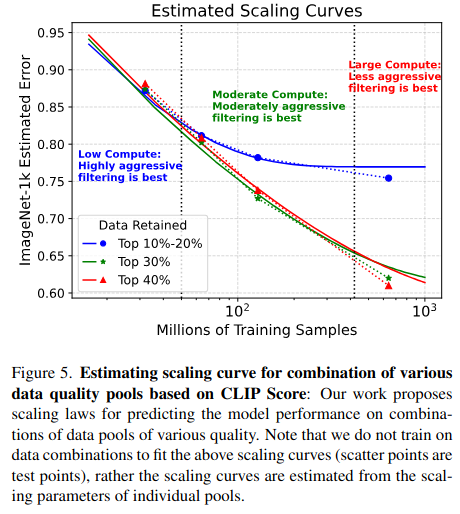
- When training for large compute(more no. of repetitions possible), the filtering/selection of the subset needs to be less aggressive.
- After multiple repetitions , the high quality data loses its utility.
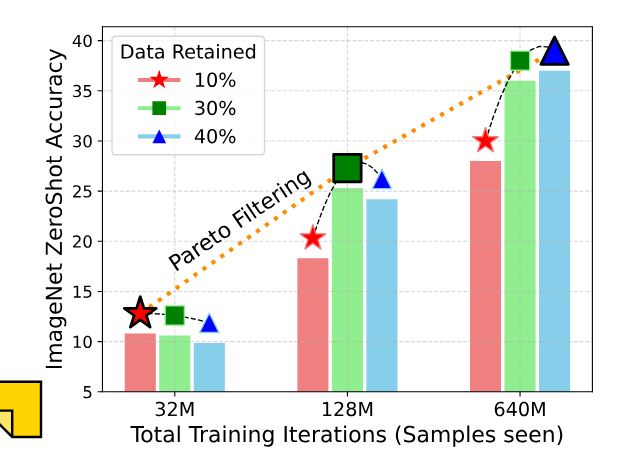
- Advantages of data filtering decreases with increase in compute amount.
Scaling Laws:
Utility
CLIP style pre-training is done by repeating multiple epochs of training on the same data. It is a metric which determines how useful a data sample is for training a model(increasing its accuracy). Obviously as training goes on an a sample is seen multiple times, its utility diminishes. The instantaneous utility is defined by the following
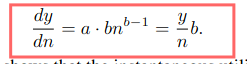 y = the error/loss of a model
n = no. of samples seen so far.
y = the error/loss of a model
n = no. of samples seen so far.
Utility Under Repetition
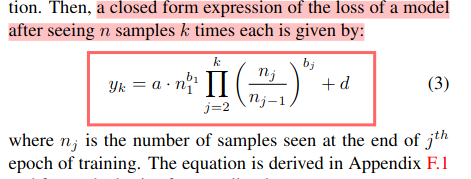
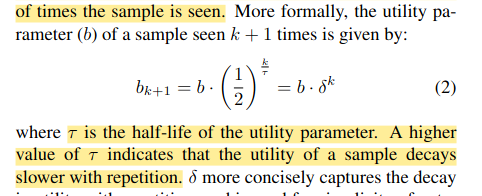
- assumes that utility decreases exponentially with repetitions
Heterogeneous Web Data
- presence of data pools of different quality is overlooked
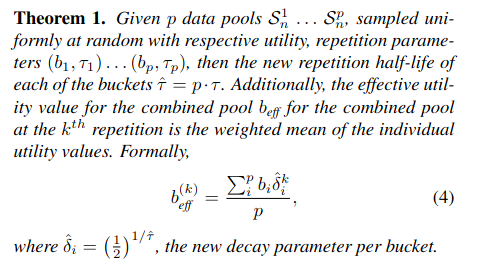
- how can we estimate the loss and thus the scaling curves for a mixture of pools effectively?
Experimental Setup
- DataComp medium scale pool which consists of 128M image-caption pairs
- T-MARS score and CLIP score as the two data utility estimates and rank the webdata based on them.
Questions
How are these scaling laws useful?
- we can train and get the params(via curve fitting) for many different pools of data
- then using theorem 1 we can find the pareto optimal data mixture for training
- Pareto Optimal refers to the best possible trade-off between model accuracy and cost of compute.
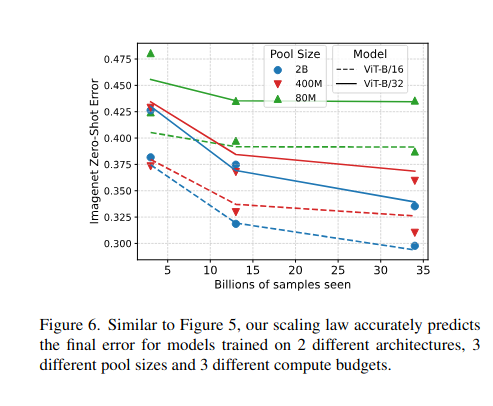
The scatter points are the real points evaluated on the real models and the lines are the plots predicted by their scaling laws
the authors used publicly available checkpoints of models already trained at massive scales at the given pool sizes to get the scatter points.
Take a look at the citations
- follow-up works- maybe LLMs?
- review ICLR openreview
continual works?