When Do Curricula Work?
Last modified: July 21, 2026
#curriculum_learning
Paper: \[2012.03107\] When Do Curricula Work?
Contributions
- investigate the implicit curricula resulting from achitectural and optimisation bias
- quantify the benefit of explicit curricula, we conduct extensive experiments over thousands of orderings spanning three kinds of learning: curriculum, anti-curriculum, and random-curriculum
- train over 25,000 models over four datasets, CIFAR10/100, FOOD101, and FOOD101N covering a wide range of choices in designing curricula
- curriculum learning, random, and anti-curriculum learning perform almost equally well in the standard setting
- Curriculum learning improves over standard training when training time is limited
- Curricula improves over standard training in noisy regime
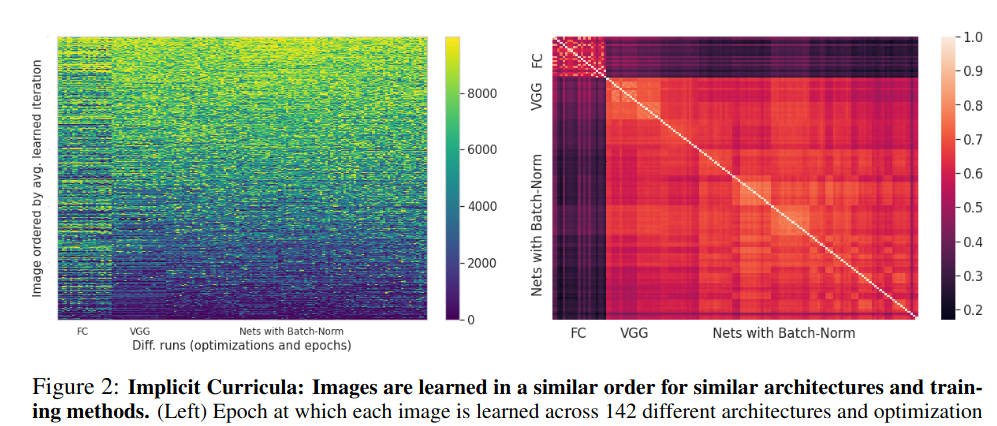
- Each row is an CIFAR image, X axis is the list of different configurations(142 in total) on which the image was trained.
- All the images have been ordered by their average value(across configurations) of the learned iteration took to get learnt.
- The redish plot is the spearman correlation matrix. It shows high values between architectural families coz the iteration orderings over the images is similar.
Implicit Curricula
The order in which the network learns the training samples from a dataset under normal SGD with iid data sampling is referred to as Implicit Curricula. It is a result of the architecture and optimisation procedure.
Scoring Functions
We define scoring functions such that samples with more score are more difficult to learn.
- Simple Loss Function: $l(f_{w}(x_{i}),y)$
- Learned epoch/iteration: $s(x_i, y_i) = min_{t^∗}\{t^∗|\hat{y}(t)_i=y_i\forall \quad t^*\leq t\leq T\}$
- Estimated c-score: itss designed to capture the consistency of a reference model correctly predicting a particular example’s label when trained on independent i.i.d. draws of a fixed sized dataset not containing that example

Pacing Functions: Forcing explicit curricula
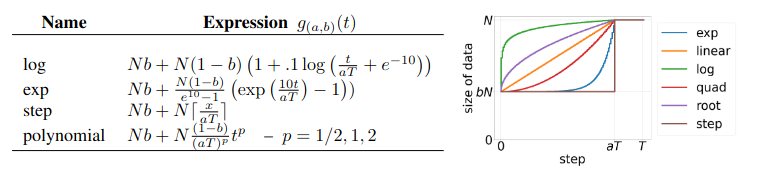 a = fraction of training till full dataset is accessed
b = initial fraction of dataset being accessed
a = fraction of training till full dataset is accessed
b = initial fraction of dataset being accessed
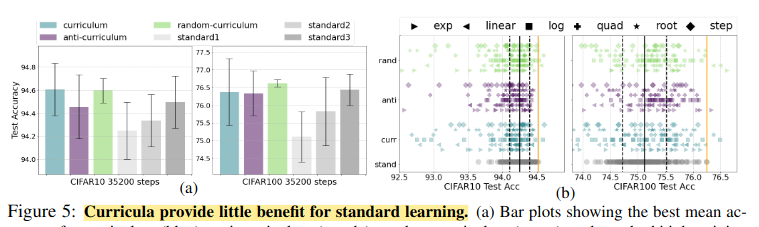
- each symbol is a (a,b) config. We observe that in the standard learning scenario with a good dataset and ample training time, curricula does not provide any benefit.
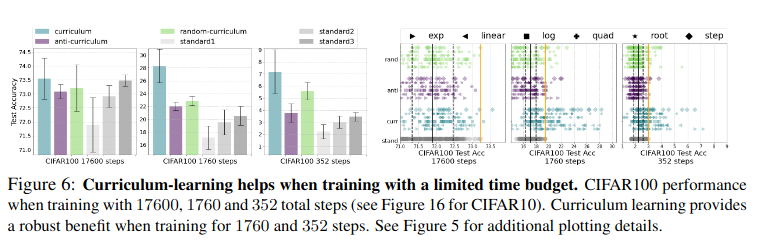
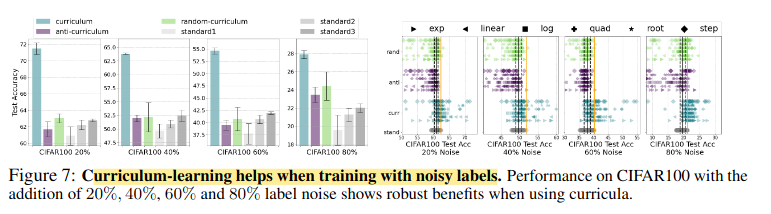
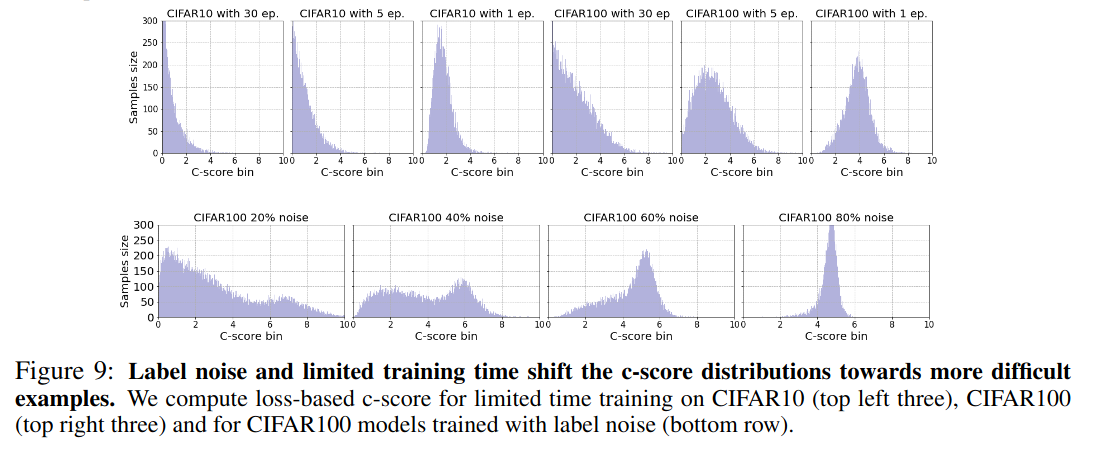
- both label noise and reduced time training induce a more difficult c-score distribution and curricula can help by focusing first on the easier examples.
Curricula in the large data regime
- Large data like FOOD101 and FOOD101N
- Again, we observe none of the orderings or pacing functions significantly outperforms standard i.i.d. SGD learning.
- Similar conclusions as before
- Curricula only helps for limited time or noisy label scenarios